Shot & Shell
SHOT & SHELL
Naval warfare from the ram to the missile —
480 BC to 1982
Turn-based or Real-time naval strategy. Two and a half thousand years of naval warfare.
You give each ship her engines, her gunnery, one special order, her damage-control party, and where she is to steer. Everything else — armour and obliquity, spotting chains, fires, flooding, list and trim, crew morale, sea state, light and land — is worked out, and reported in the language a ship's officer would use.
Splashes around Seydlitz cannot be told apart; corrections go astray. Fire reached the after magazine. USS Monitor cannot reach CSS Virginia: 2,400 yards, and her guns carry 1,800. The Short 184 takes station over SMS Lutzow and begins spotting for the guns.
Fourteen actions, either side of every one
Ram and board in narrow water. No armour, no guns.
Wear across their sterns and rake, or lay alongside.
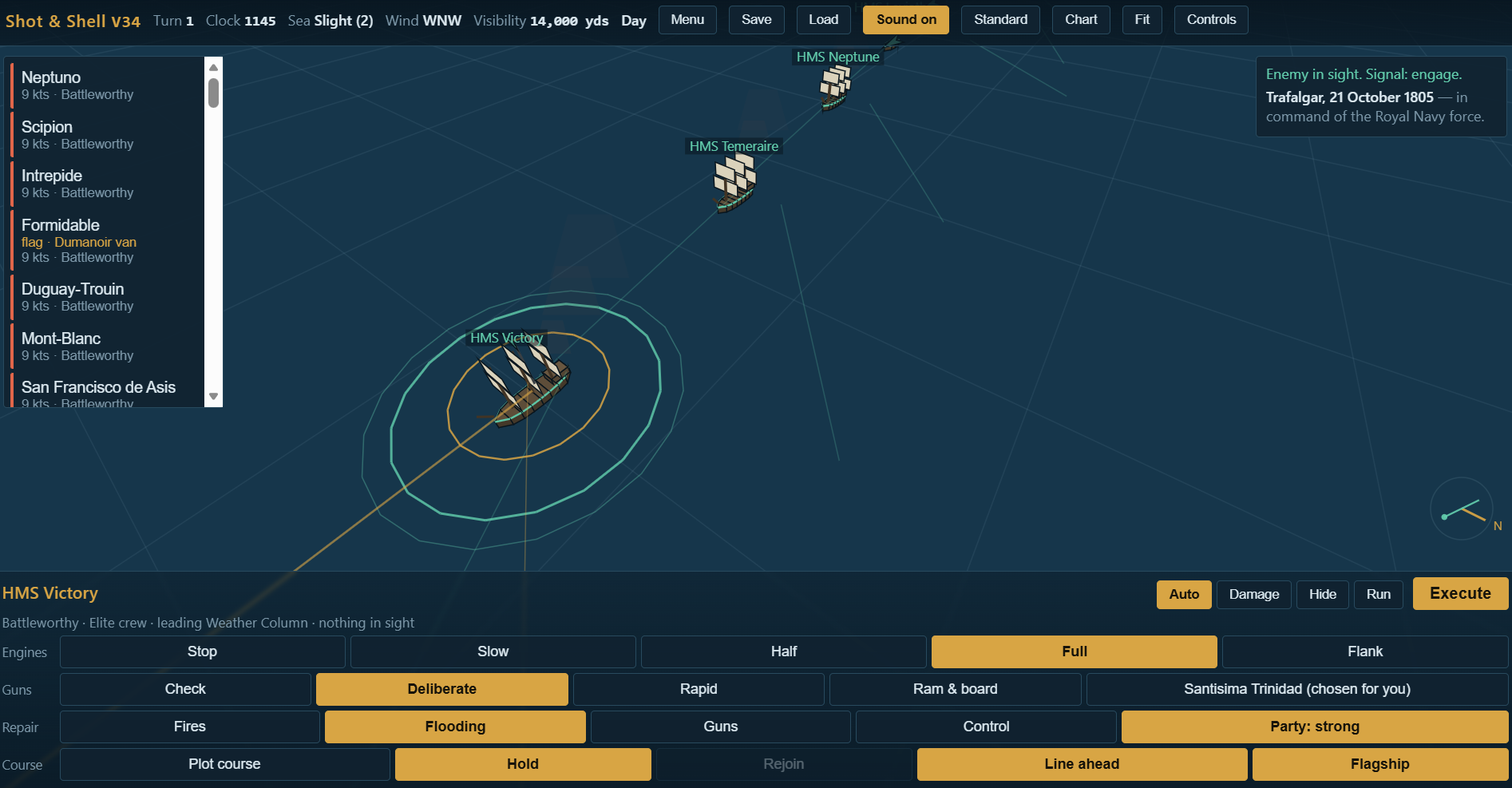
All seventy-one ships. Nelson's two columns against Villeneuve's line.
Guns that can barely hurt armour; a ram that certainly can.
Fourteen inches of Krupp steel against quick-firing guns.
Armoured cruisers with wooden decks, running for the open sea.
Plunging fire, cordite, and a rear ship that cannot keep up.
Forcing a channel with a battery on either headland.
Engadine hoists out her Short 184 to work over the German line.
A heavy cruiser alone against destroyers in the dark.
Two carriers have found each other at last.
Four laden ships, a thin escort, and U-boats working in.
An escort carrier caught by heavy cruisers in a rain squall.
Missiles over the horizon.
| Salamis, 480 BC |
| Cape St Vincent, 1797 |
| Trafalgar, 1805 |
| Hampton Roads, 1862 |
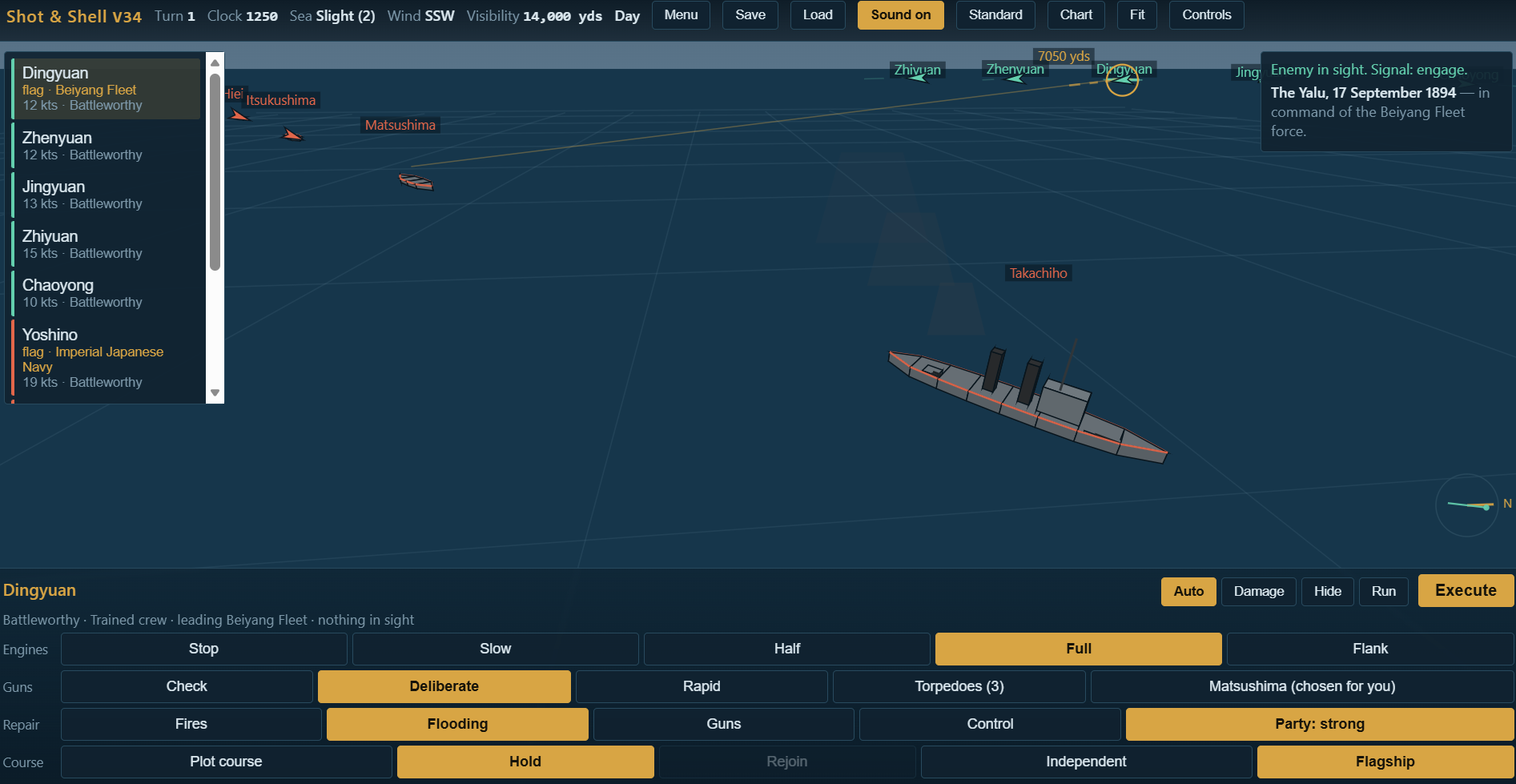
| The Yalu, 1894 |
| Off Santiago, 1898 |
| Dogger Bank, 1915 |
| The Narrows, 1915 |
| Jutland, 1916 |
| Cape Espartel, 1936 |
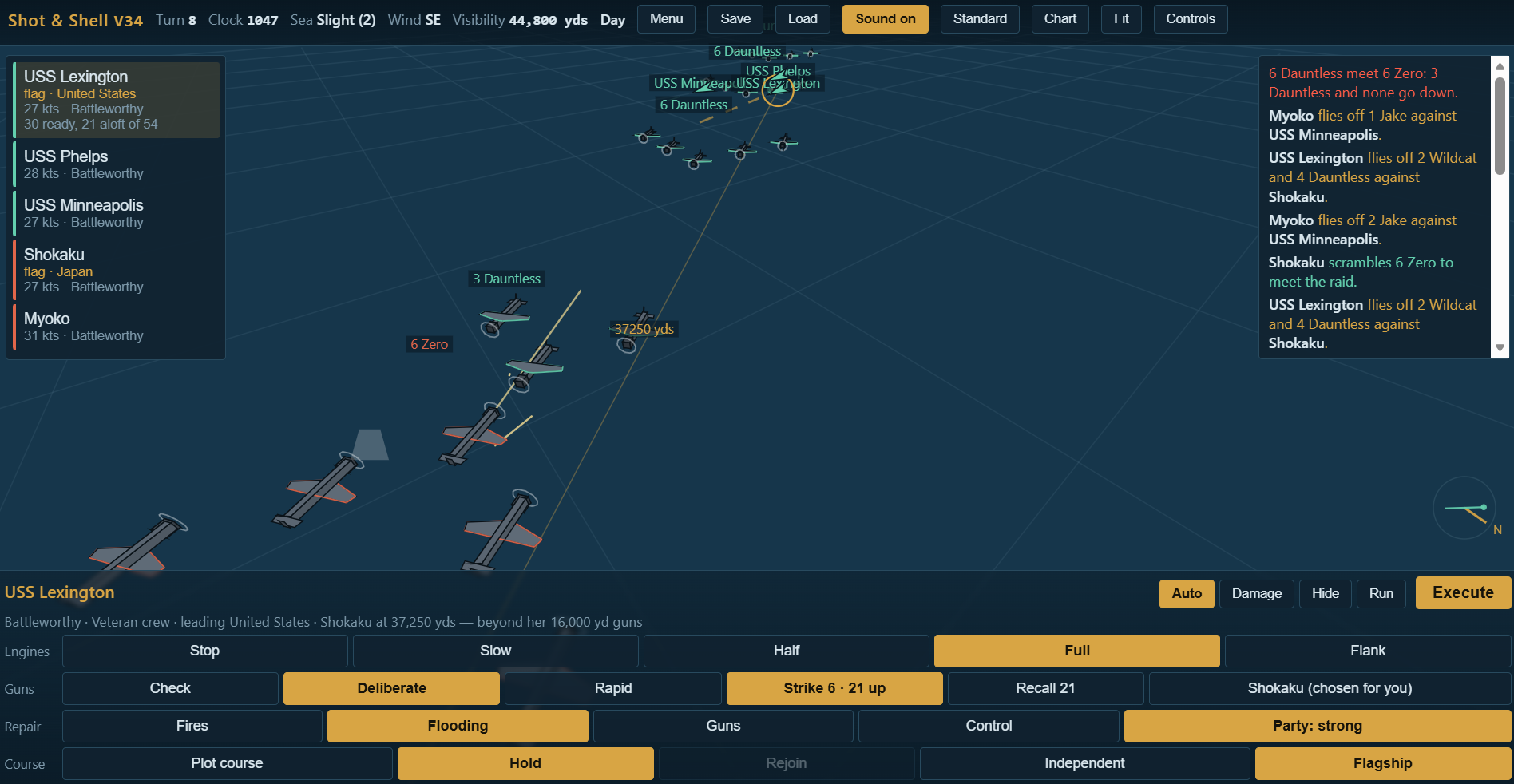
| Coral Sea, 1942 |
| North Atlantic, 1943 |
| Off Samar, 1944 |
| South Atlantic, 1982 |
Every scenario is playable from either side, by its proper name — Union or Confederate, Royal Navy or Hochseeflotte, Beiyang Fleet or Imperial Japanese Navy.
What is going on under the hood
Gunnery that knows what it is doing. Hit chance falls with range and is modified by crew quality, morale, fire-control damage, casualties, your own list, your own smoke, sea state weighted against small calibres, the target's angle on the bow, her speed and helm, and the light.
The spotting chain. Fire at one ship at a steady range and your corrections improve salvo by salvo. Change target, check fire or lose your bridge and it resets.
Splash confusion. Two ships of similar calibre firing at one target cannot tell their falls of shot apart, and both shoot worse for it. Dye-loaded shells, radar direction and an aircraft overhead each break the tie. Concentration is not free — and the automatic target assignment knows it.
Armour and obliquity. Fall angle decides deck or belt; belt armour is divided by the sine of the angle on the bow. Plunging fire finds magazines and machinery; flat fire finds batteries and the conning tower.
Twelve compartments per ship, renamed by era — oar banks, mainmast and yards, boiler rooms — with integrity, fire and water in each. Machinery sets your speed, the bridge sets your fire control, a battery hit knocks out mountings, the steering gear jams.
Fires spread, blind your own gunners, and reach magazines. Flooding admits water to one side, gives you list and trim, unworks the low broadside past sixteen degrees, and founders, capsizes or takes you down by the head. Damage control is a claim on the same crew that fights the guns.
Morale breaks ships off — including yours. An order is a signal, not a guarantee.
Weather, light and land. Sea state, wind that drifts smoke and blows your own funnel haze down the range, visibility, a clock running through night, dawn, day and dusk, searchlights, shoals that ground you and headlands that block your sight.
Everything that floats, flies or dives. Ram and boarding with marines and prizes taken. Sail with points of sail, raking fire and being caught in stays. Torpedoes you do not see until the wake is three hundred yards off. Aircraft by name — Wildcat, Hellcat, Zero, Avenger, Kate, Short 184, Sea Harrier — flying off six at a time, fighting through, and coming home to forty-five minutes of rearming. Submarines that dive and surface at your order. Coastal batteries standing on real land. Missiles engaged by area weapons, then close-in, then the hit.
Commanding it
Fleets and flagships. Every ship belongs to a division with its own flag and its own formation — line ahead, line abreast, echelon. Steer the flag and the division follows her wake, taking station from her actual track so the line turns in succession. Break a ship out with a plotted course; call her back with Rejoin. Lose a flagship and the next ship hoists the flag.
Turn-based or real time — you choose before the action. In turn-based, one press advances a minute, and Run resolves minute after minute by itself, stopping the moment your guns come into range, a fresh contact appears, a torpedo track is sighted or a ship is lost. In real time the clock runs at ×1 to ×16, and at ×1 a twenty-three knot battlecruiser crosses her seven hundred yards while you watch.
A plot you can handle on a phone. One finger drags the water under it. Two fingers pinch to zoom about the point between them, twist to swing the bearing, slide to change the angle. Step the view down through plan, standard, low, silhouette, awash and below the surface, where you see hulls and the tracks of torpedoes running at depth. Tap a ship or her name to take command and centre on her. A full tactical chart shows the whole action, north up, with contacts you have lost held at their last known position and aged in minutes — tap it and the plot jumps there.
Damage at a glance. Every compartment and component is a bar running green through amber to red, the figure inside it, fire and flooding annotated alongside.
Save and load to a JSON file you keep.
Technical
- One HTML file. No installer, no dependencies, no network. Open it and play.
- Runs offline from your downloads, on a phone, tablet or desktop browser.
- Hand-written software 3D renderer on a 2D canvas — no WebGL, no engine, no libraries.
- All sound synthesised at runtime. Nothing is downloaded.
- 49 ship classes, 13 aircraft types, 14 scenarios, either side of each.
- Trafalgar's seventy-one ships resolve in 27 ms a turn and render at 60 frames a second.
Download
Development log
- Update 10 Sept 20263 days ago
Leave a comment
Log in with itch.io to leave a comment.