Ridgeline: General Command
RIDGELINE — General Command
A beer-and-pretzels hex wargame, inspired by Panzer General and the like, spanning over three thousand years of land, sea and air warfare. One HTML file. No install, no account, no dependencies.
The short version
Pick an era. Pick an army. Fight a battle on a 3D hex map that generates itself, or take one of 53 historical scenarios from Kadesh to a hypothetical war in the Taiwan Strait.
Every era plays by different rules — not different unit stats, different rules. A Napoleonic square is not a Great War trench is not a modern drone screen. Learning what each age rewards is most of the game.
It runs in a browser tab, on a phone or a desktop, offline, forever. The whole thing is a single 830 KB HTML file with no external resources and no browser storage.
What's in it
11 eras, each with its own combat model
53 historical set-piece battles
81 command cards plus per-era support missions
The eleven eras, and what each one is about
Every era has its own combat model with a name, stated in the interface. These aren't flavour text — they're the actual arithmetic.
Classic — the original rules. The game as it began. No initiative, no entrenchment, no experience, no ammunition, no supply, no morale. A flat board, a ridge in the middle, six formations a side. Position and nothing else.
Ancient (800 BC – 500 AD) — shock and flank. Lines that break when taken from the side. Elephants, phalanxes, and the reason nobody wanted to be outflanked.
Medieval (500 – 1500) — the charge and the armour. Knights are nearly unstoppable in the open and nearly useless against set spears.
Renaissance (1500 – 1700) — pike, shot and the sap. Combined arms, literally: a formation with a different arm alongside fights 25% harder; one standing alone fights worse.
Age of Reason (1700 – 1789) — the line, the volley and the flank. Stand still and you're a formed line: +35% fire, and cavalry loses nearly half its weight against you. Move and you're neither firing nor formed. But a line cannot refuse a flank — a second attacker gets +45%. That single trade is Frederick's oblique order, the Carolean charge, and Cowpens.
Napoleonic (1789 – 1815) — the square, the horse and the gun. The three-cornered trap. Cavalry rides down unformed infantry; squares shrug it off; artillery butchers squares.
Industrial (1850 – 1900) — the rifle. The age when frontal attack became ruinous and entrenchment became decisive.
The Great War (1914 – 1918) — wire, the gun and the machine gun. Trenches, gas that drifts on the wind, and mines dug under the enemy line and fired when you choose.
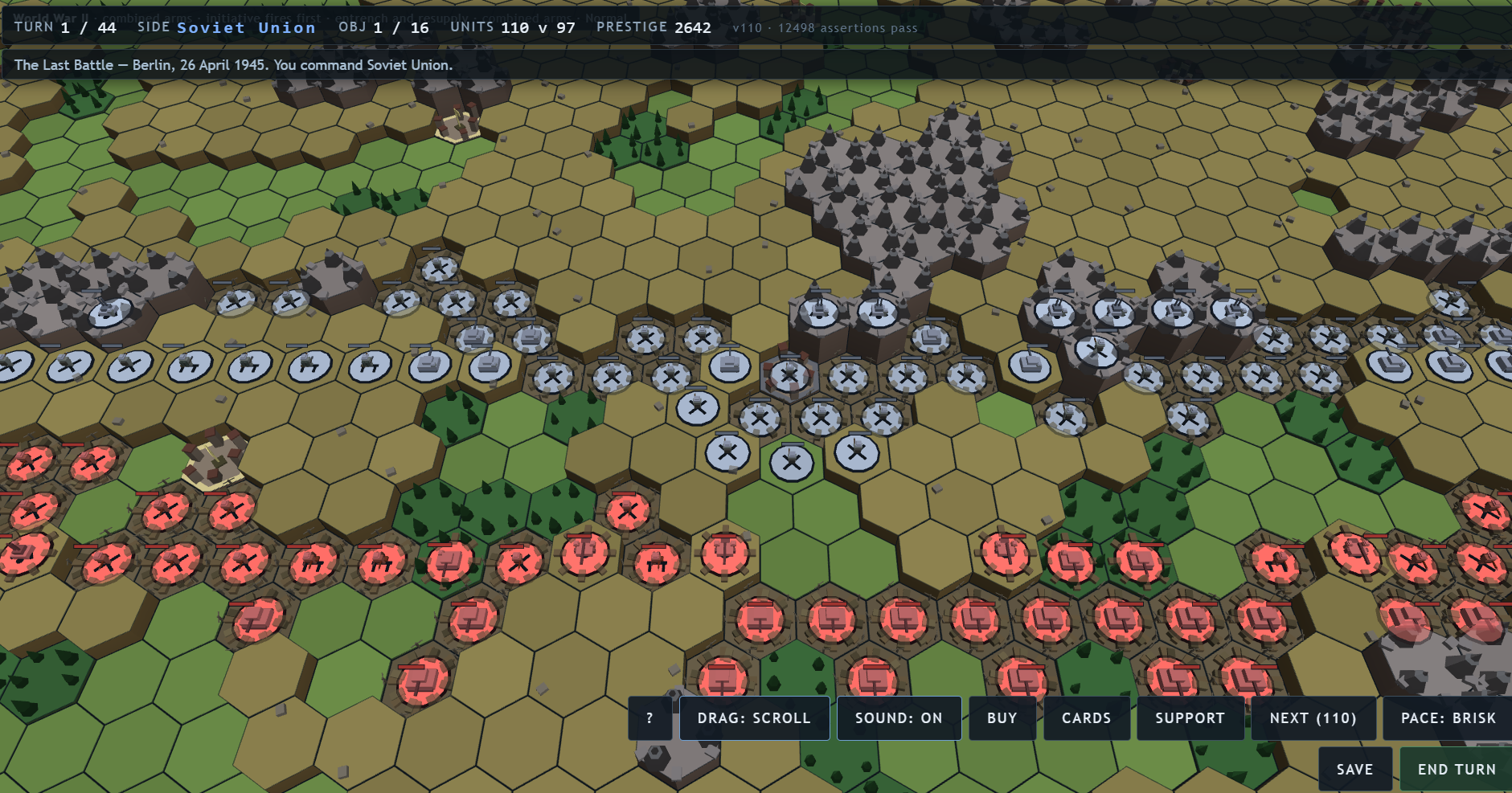
World War II (1939 – 1945) — combined arms. Armour, infantry and guns that need each other.
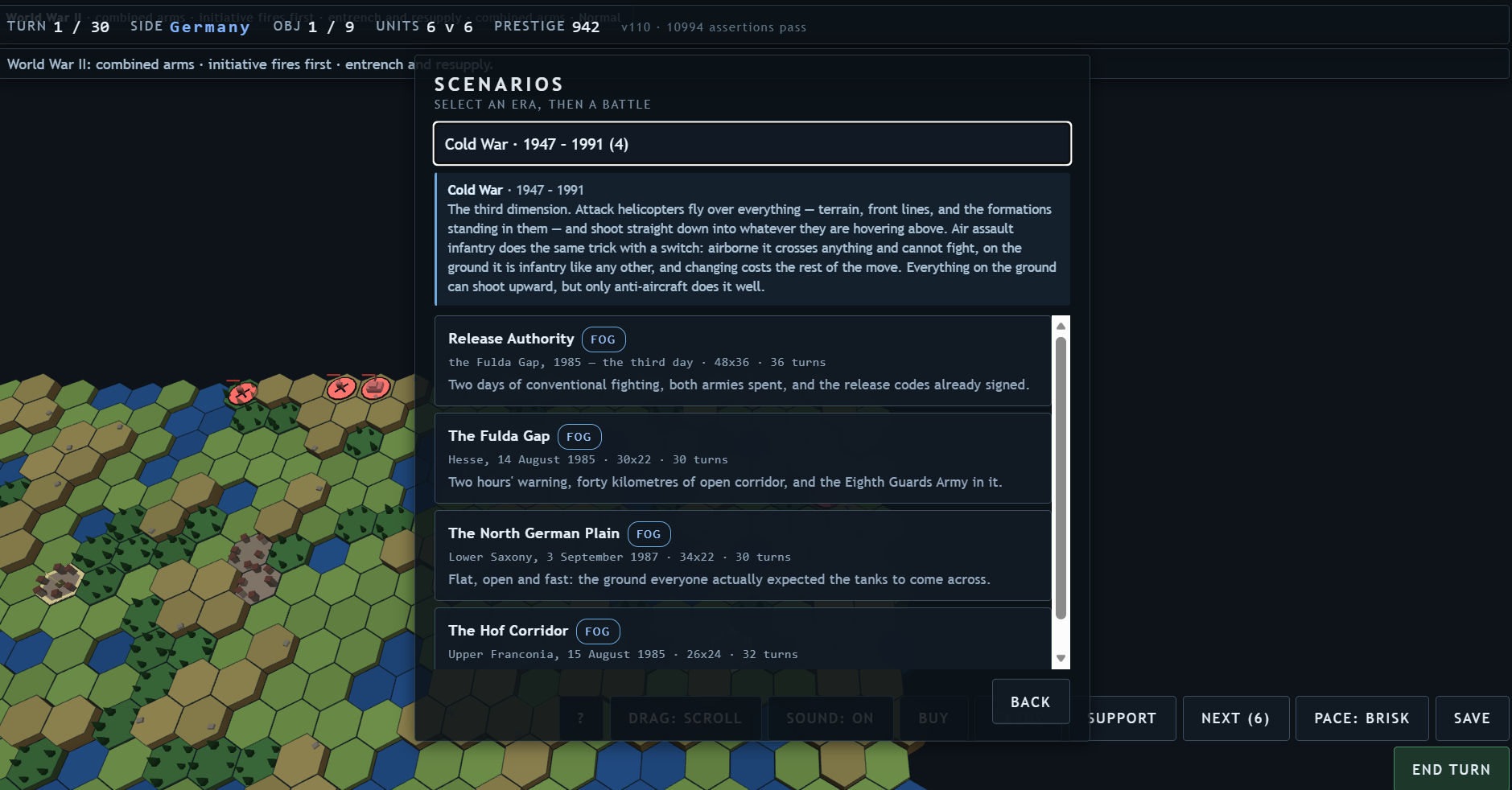
Cold War (1947 – 1991) — the third dimension. Helicopters and air assault fly over everything the ground can do. A second map layer: a hex holds a ground formation and an aircraft at once.
Modern (1991 – present) — the transparent battlefield. There is always a drone overhead. Anything that moves is seen — fog doesn't hide it — and is fought at 20% less defence while still in the open. Drones are formations you fly yourself, and a cheap one kills a tank at +50%. The counter to all of it is stillness, cover and dispersion.
Core systems
Prestige, cards and support
You earn prestige each turn from ground held. Spend it on reinforcements, on support missions (artillery, air strikes, naval gunfire, reconnaissance — different in every era), or on command cards: one-off orders with real drawbacks, drawn from that army's own history. Massed Artillery hits harder and burns your ammunition budget. Gå-på attacks 40% harder and leaves nothing in reserve.
Prestige cards can't be farmed — each play costs more and returns less, and any card is a net loss by its second use.
Anti-aircraft that actually works
Air defence within two hexes of a target suppresses an air strike by up to 72%, and with two or more batteries in range there's a real chance the mission is broken up entirely — the target takes no damage, only shaken nerves. Every nation's air defence has its own quality: German 88s at 1.35, Japanese guns at 0.70.
Naval warfare
Three rules make a fleet action unlike a land battle, because ships never recover:
- Finding the range — hold fire on one ship and every salvo after the first hits 32% harder
- Flooding — damage costs speed permanently; a battered ship can neither run nor catch
- The magazine — a hit may reach the cordite and end a ship outright. Per hit: battlecruiser 9.6%, destroyer 4.5%, dreadnought 1.7%. Britain lost three battlecruisers that way in ninety minutes at Jutland.
Amphibious assault
Attacking out of the water is worth about a third of normal — unless there's a landing ship alongside, which raises it to 72%. That makes the transports the centre of the operation and the first thing worth sinking.
Tactical nuclear weapons, and mutual assured destruction
Available only in Cold War and Modern scenarios that hold release authority — and only five of them do. Everywhere else the weapons exist and nobody may use them, which was true of almost every day of the Cold War.
Where they are released:
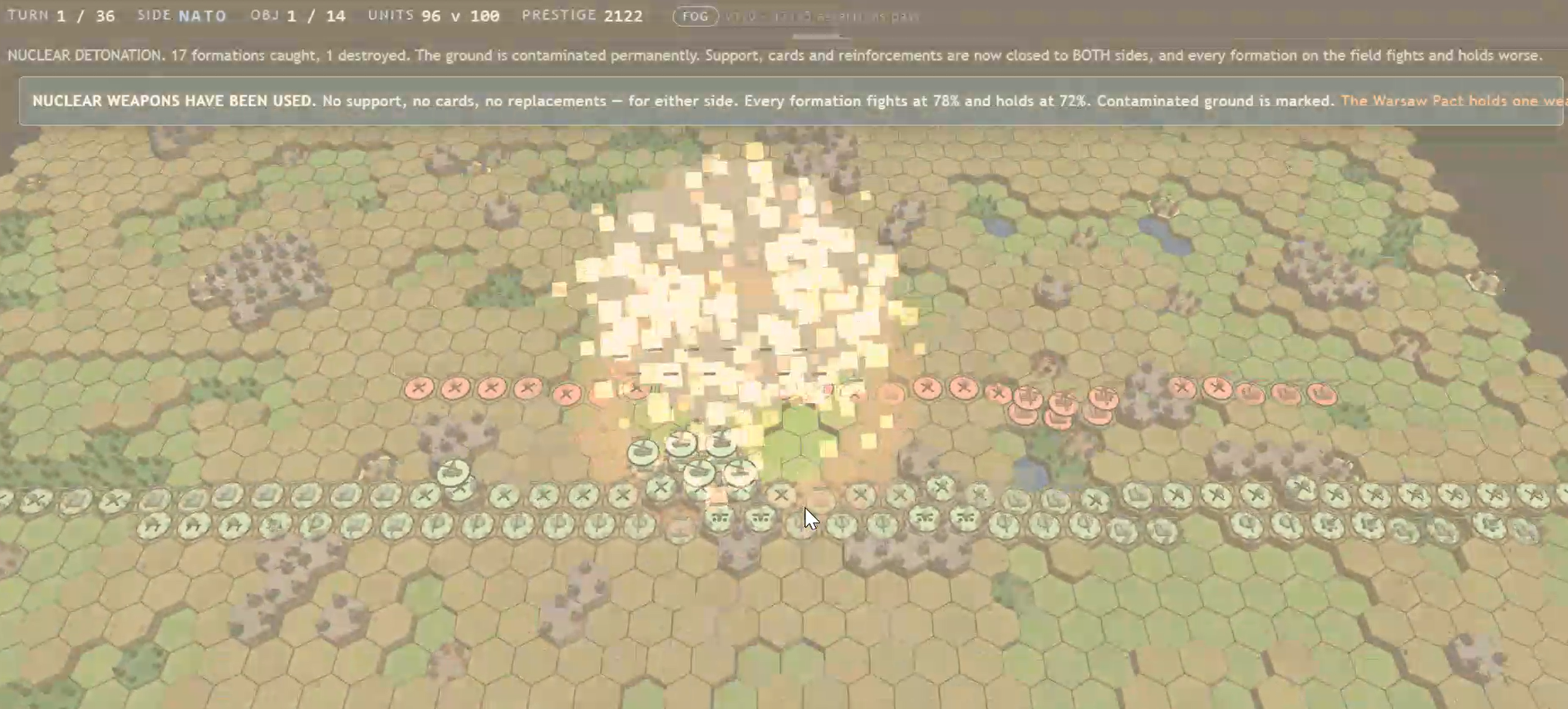
- Delivery is watched: a strategic bomber flies the run in (Cold War) or a warhead arrives near-vertically (Modern). Screen-filling white flash, rising mushroom cloud, and the heaviest camera shake in the game — eight times a landmine, sustained for three seconds.
- Damage falls off by ring: 98% / 75% / 45% / 22% of current strength. Armour takes 42% of what infantry takes.
- The ground stays permanently contaminated, marked on the map, costing infantry strength every turn they stand in it.
- Crossing the threshold ends the war as a contest. No support, no cards, no reinforcements — for either side — and every formation on the field fights and holds worse, including yours.
- The other side keeps exactly one weapon in reply. The Support button reads RETALIATE. Using it closes everything for them too.
- Air defence cannot stop it.
Going first doesn't win the battle. It buys you a ruined enemy and a warhead coming the other way. That's the whole of deterrence in one rule — and it makes the bomb a bad trade unless you were losing anyway. The AI applies the same arithmetic: it only ever starts a nuclear exchange late, losing badly, and with a concentration worth spending the rest of the war on.
Six scenarios worth starting with
The Ridge (Classic) — A 20×16 board. Flat ground, one block of hills across the centre, six formations a side, identical forces. No morale, no ammunition, no experience. The ridge is the entire battle. This is the game stripped to its bones.
The Army in Four Pieces (Kadesh, 1274 BC) — Ramesses marched in four divisions strung out over twenty miles of road. Your army starts in five separate camps down the length of the map; two and a half thousand Hittite chariots are massed on your flank, already across the ford. Getting the four pieces into one army is the battle.
The Narrow Gorge (Okehazama, 1560) — Twenty-seven formations against fifty-eight. They're asleep in five camps down a wooded gorge; you are one concentrated fist on their flank, and every formation you have acts two steps sooner. Reach the command post before the rest of that army works out what's happening.
Three Thousand Matchlocks (Nagashino, 1575) — The finest cavalry in Japan against three lines of palisade and massed arquebus. Deliberately a straight line, because the point is what happens when horse meets prepared shot. Takeda cavalry against a spear hedge: 0.39.
The Run to the North (Jutland, 1916) — Ninety capital ships and destroyers on open ocean with no land anywhere on the map. Find the range, watch for the magazine, and remember that a battlecruiser is battleship guns behind cruiser armour.
Release Authority (Fulda Gap, 1985) — Two days of conventional fighting, both armies spent, ninety formations a side in contact, and both sides holding release authority. Use it because you're losing, or don't use it.
Also included
- Scenario editor — paint terrain, place any formation from any army with its own starting strength, morale and entrenchment (including aircraft already airborne), set objectives, mines, opening move and release authority, author your own cards and support missions, and export the whole thing as JSON. Edit any of the 53 built-in scenarios without touching the original.
- Play either side of any historical scenario — and if you take the side that historically moved second, you move second.
- Spectate (the computer commands both armies) and hotseat (two players, one device, the fog changes hands with the turn).
- Four difficulty settings that name which army carries the advantage, in words, so "Impossible" is never ambiguous.
- Save and load to a file you own — portable between machines, nothing that expires.
- Fog of war, adjustable enemy-turn pace, and starting distances from Distant to Contact.
Requirements
Any modern browser with WebGL. Works on phones. Runs offline. Nothing is uploaded anywhere — there is no server, no account, and no analytics.
A note on what this is
This is a beer-and-pretzels wargame: the rules fit in a paragraph, the interface tells you the arithmetic before you commit, and a battle takes twenty minutes. It is not a simulation. What it tries to do is make each era feel like itself — so that winning at Nagashino teaches you something that doesn't work at all in 2027.
Modern scenarios depict real and hypothetical conflicts and are modelled from published accounts. They're offered as wargames and explorations of military challenges, not as commentary.
Download
Development log
- Update 4 Sept - Landmines2 days ago
- Update 2nd Sept 20263 days ago
Leave a comment
Log in with itch.io to leave a comment.